Most late payments are not caused by bad customers. They are caused by a process that makes it easy to pay late: a vague verbal agreement, no deposit, an invoice sent a week after the job, and a first chase three weeks after that. Fix the process and most of your invoices get paid, without you having to be the bad guy.
This guide covers the five habits that keep cash flowing in a small trades business: deposits, payment terms in writing, invoicing on the day, chasing on day one, and knowing what you can charge when a customer still does not pay.
Why do tradespeople get paid late?
Three reasons come up over and over.
First, the customer does not know when payment is expected. You agreed “a couple of weeks” on site, and their memory of that conversation is worse than yours. Second, the invoice arrives late, so the clock starts late. Third, nobody chases. The customer pays the invoice that makes the most noise, and silence is quiet.
None of that is malice. It is friction, and friction is fixable.
Start with a deposit
A deposit does two things. It covers your materials, and it filters out the customers who were never going to pay comfortably.
For most jobs, a deposit that covers materials is a fair request, and most customers expect it. Large jobs with expensive materials should be a bigger deposit. Some trades take a third up front and stage payments for the rest. What matters is that the deposit is agreed in writing before work starts, not mentioned on the day you arrive.
If a customer pushes back hard on a modest deposit, that is information. Use it.
Put payment terms in writing before the job starts
The single highest-leverage habit in this list: state payment terms on the quote, and again on the invoice. “Payment due within 14 days of invoice” or “payment on completion” written down beats a verbal agreement every time, because it removes the argument later.
If you are not sure what terms to set, think about the job. Small one-day jobs suit payment on completion. Anything bigger suits a deposit plus 7 or 14 day terms. The point is to choose deliberately, and to write it down. There is a practical rundown of the common terms, including your rights around late payment, in this guide to Invoice payment terms.
Send the invoice on the day the job finishes
An invoice sent the day the job ends gets paid before an invoice sent on Friday. Do not let invoices pile up. The customer is happiest with the work right after it is done, and that is exactly when the invoice should arrive.
For most tradespeople this means sending invoices from a phone, on site, before you drive away. If that is not your current habit, it is the easiest one to adopt, because the information is still fresh: what you did, what it cost, what was agreed.
Chase on day one of overdue, not week three
The first chase is the most effective one. When an invoice passes its due date, send a friendly reminder the same week, not a stern letter a month later. Most late payments end at this stage, because it was oversight, not bad faith.
If the polite nudge does not work, escalate in steps: a firmer request with a date, then a final demand. Keep it professional throughout, and always offer a way out: a customer with a dispute will often pay once the dispute is resolved.
What you can charge when they still do not pay
UK law is on your side here. Under the Late Payment of Commercial Debts Act 1998, a business can charge interest on a late commercial payment: statutory interest at 8% above the Bank of England base rate, plus a fixed compensation amount, typically £40 for debts under £1,000, £70 for debts between £1,000 and £10,000, and £100 for larger debts. Your right to charge interest starts the day after the payment becomes overdue.
Most small tradespeople never use this, and you may never need to. But knowing the numbers changes how you negotiate: mentioning that interest and compensation will apply from a specific date is enough to move most invoices.
If you want the exact figure for a specific invoice, this statutory interest calculator works it out in seconds.
What tools make this easier?
The habits above collapse into a simple workflow: terms on the quote, invoice on the day, reminder when overdue. Software exists to carry that workflow, so it survives busy weeks.
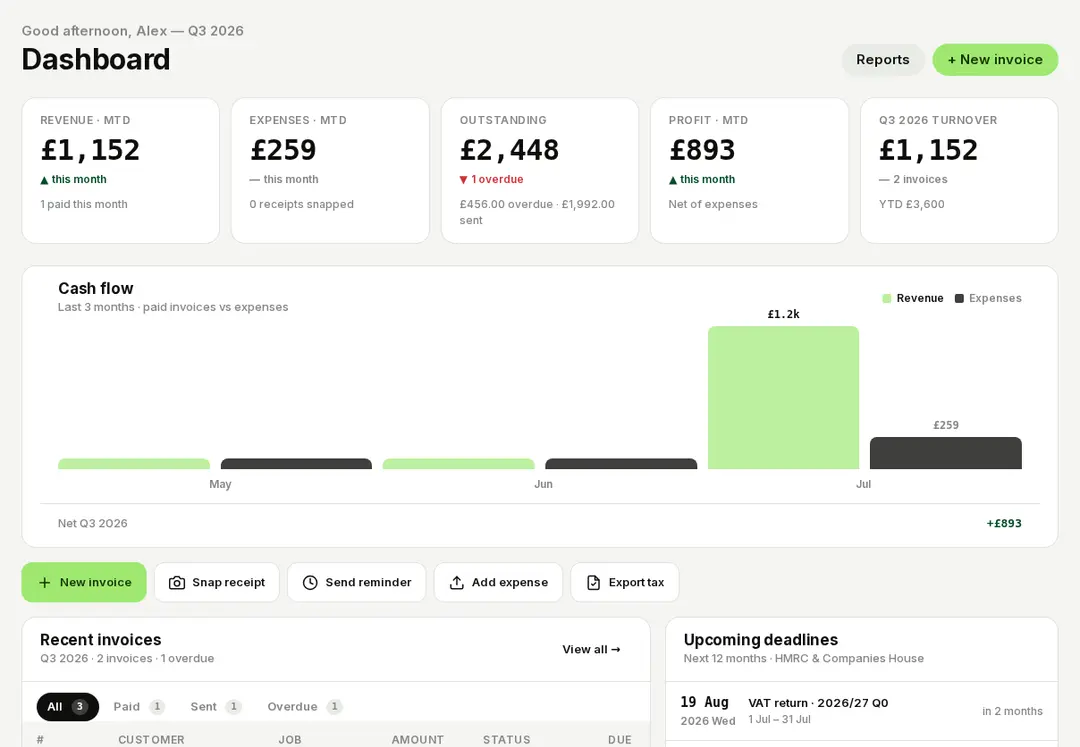
TradeTally is an invoicing app built for UK tradespeople, by someone who still works the tools. You send invoices and quotes from your phone, see at a glance what is sent, paid and overdue, and use the built-in late payment calculator when customers stall. It is built for the way trades actually invoice, without the accounting-software overhead.
What to do next
Pick one habit and start this week. The cheapest one is also the most valuable: put payment terms in writing on your next quote. Add a deposit to the job after that. Then, next time an invoice goes overdue, chase on day one instead of week three.
Your cash flow is a process problem. Treat it like one, and the late payments start drying up.