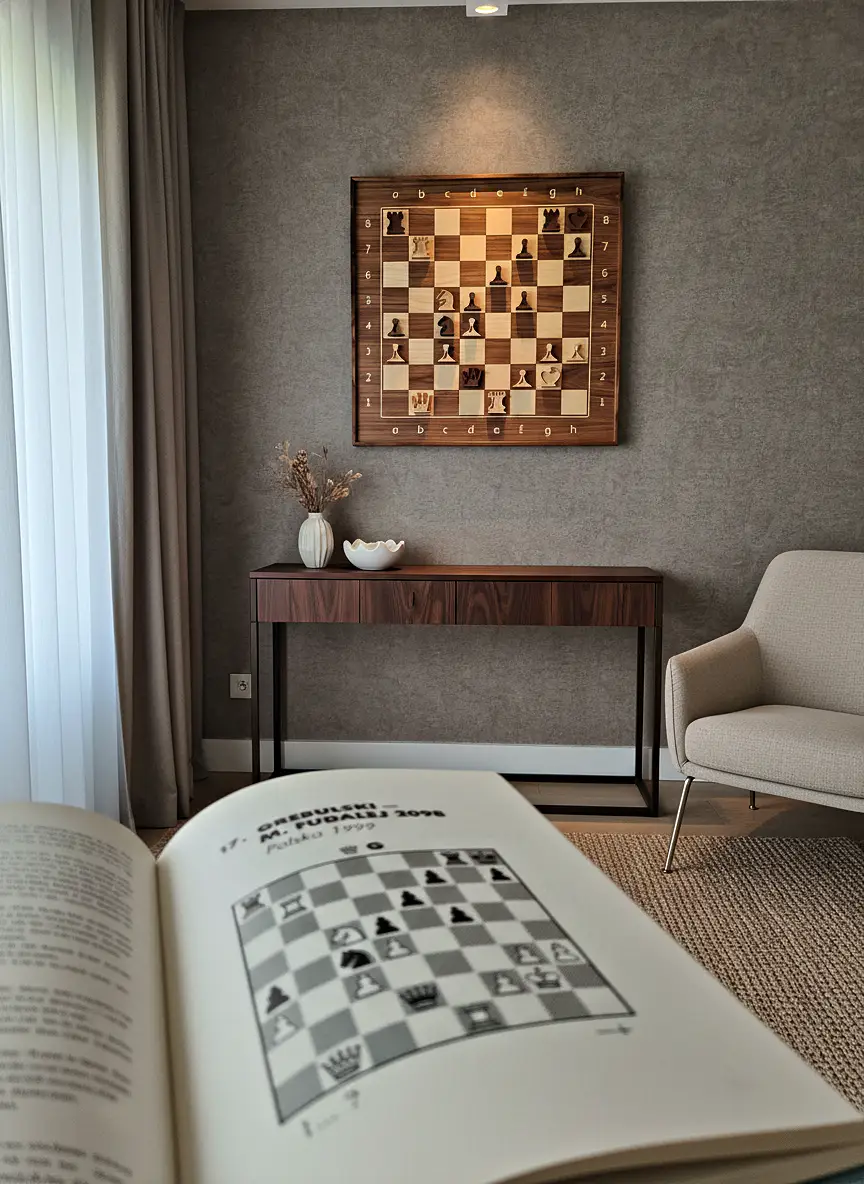
A chess board does not have to live in a cupboard between games. More and more players, and plenty of people who simply love good design, now hang the board on the wall like a painting. It looks great when nobody is playing, and it is ready for a game the moment someone walks past. If you are thinking about adding one to your home, here is what is worth checking before you buy.
Start with how the pieces stay in place
The first practical question is what keeps the pieces on a vertical surface. In most cases the answer is magnets. Pieces with a magnet in the base snap onto the squares and stay put through a long game, and the magnets can be hidden inside the board, so from the front it looks like an ordinary wooden board. Ask how many magnets there are and how strong they are, because weak ones let pieces slide when someone bumps the wall. If you want a wider comparison of designs and formats, this guide to vertical chess boards explains the main types and what sets them apart.
Think about size and weight
Wall boards range from small travel-sized models to large statement pieces. A board around 80 cm square is big enough to play comfortably with full-size pieces and to become the focal point of a room. The trade-off is weight: a solid wood board of that size can easily reach around 12 kg, so the wall and the hardware matter as much as the board itself.
Choose real wood if you can
The material changes both the look and the lifespan. Solid wood stays flat, feels warm to the touch, can be refinished if it gets scratched, and gets better with age. Veneered or composite boards can be cheaper, but they rarely age as well. Natural contrast also looks better than paint: a dark species such as American walnut next to a light one such as ash gives clear, readable squares without any coloured finish.
Plan the hanging before the purchase
A heavy board needs a solid fixing. Find a stud or use anchors rated well above the board’s weight, use two hanging points so the load is shared and the board stays level, and choose a height where the centre of the board sits near eye level. Avoid hanging it on a single screw in plain drywall. For a step-by-step walkthrough, see this guide on how to hang a chessboard on the wall.
Don’t forget the pieces
Pieces with felt bases protect the surface of the board and make a quiet, pleasant sound when you move them. Keep them in a small box or drawer near the board so a game can start without a search.
A handmade example
If you are looking for a reference point, the ChessboArt800 solid wood wall chess board is a good example of the approach described above: an 800 × 800 mm board in a solid wood frame with hidden neodymium magnets, made to order in Poland. Because each board is built individually, expect to wait a few weeks for delivery, which is worth knowing if you are buying a gift.
The short version
Decide how the pieces will stay on the board, pick a size your wall can carry, favour solid wood, and plan the fixing before you order. Get those four things right and a wall-mounted chess board will give you years of games and a piece of decor you will not want to take down.