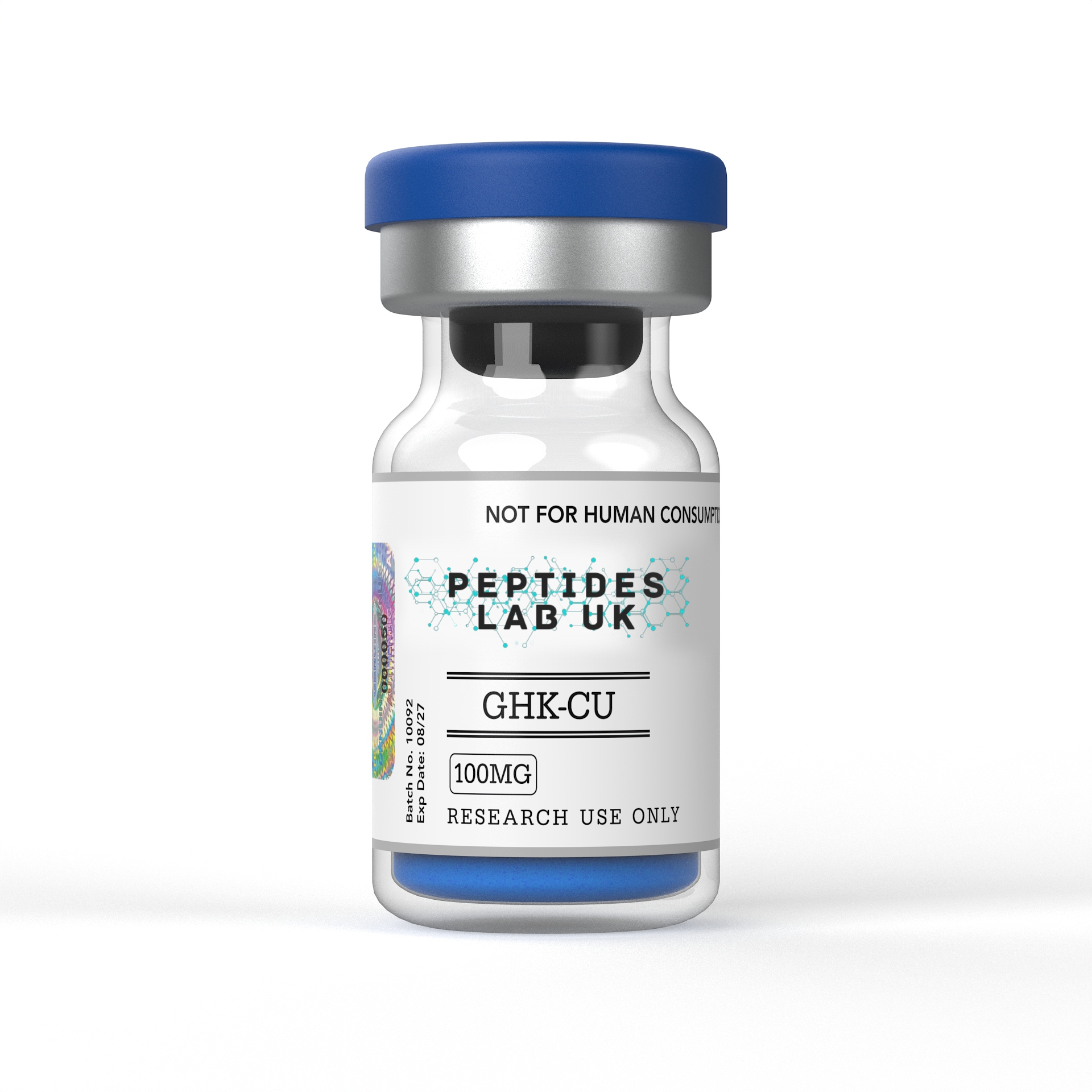
GHK-Cu is a naturally occurring copper-binding tripeptide, composed of glycine, histidine and lysine, that complexes with a copper(II) ion. First isolated from human plasma in the 1970s, it has since become one of the most extensively studied copper peptides in extracellular matrix research. Laboratories investigate GHK-Cu primarily for its role in modulating collagen synthesis, tissue remodelling and wound-repair signalling pathways in cell and animal models. It is supplied to research institutions as a lyophilised research compound, strictly for in-vitro and laboratory investigational use.
What Is GHK-Cu Copper Peptide?
GHK-Cu (glycyl-L-histidyl-L-lysine copper) is a small copper-binding tripeptide with a molecular weight of approximately 340 g/mol. Structurally, it consists of the three-amino-acid sequence GHK bound to a single Cu²⁺ ion through the histidine imidazole ring, the terminal amine and the peptide backbone nitrogen.
The peptide occurs endogenously and has been detected in human plasma, saliva and urine. Its concentration in plasma has been reported to decline with age, falling from roughly 200 ng/mL in early adulthood to around 80 ng/mL by the sixth decade of life, a pattern first documented in the original plasma-fractionation work that identified the compound. This age-related decline is one of the reasons the copper peptide has attracted sustained interest in tissue-regeneration research: its natural presence, combined with its apparent decline over time, has made it a candidate signalling molecule for studying how extracellular matrix turnover changes with age.
Unlike synthetic growth-factor mimetics or receptor agonists engineered for a single target, GHK-Cu peptide behaves more like a carrier and signalling molecule. Its defining structural feature, the copper-binding site, is central to its biological activity, which is why researchers generally study the copper-bound complex rather than the uncomplexed GHK peptide alone.
Mechanism of Action
The primary documented action of GHK-Cu is copper delivery to enzymes that regulate extracellular matrix production. Copper is an essential cofactor for lysyl oxidase, an enzyme responsible for cross-linking collagen and elastin fibres, and for other copper-dependent oxidases involved in connective tissue maturation. By binding and transporting copper, GHK-Cu is thought to support the activity of these enzymes at sites of tissue turnover.
Beyond copper delivery, in-vitro work has examined how GHK-Cu influences fibroblast signalling. Studies using cultured dermal fibroblasts have reported that copper peptide exposure is associated with upregulation of TGF-β receptor expression, which sensitises fibroblasts to pro-collagen signalling cascades. Separate work has looked at integrin expression on fibroblasts and keratinocytes; integrins function as mechanoreceptors that influence collagen gene transcription, and some in-vitro data suggest GHK-Cu modulates their expression alongside the transcription factor p63.
GHK-Cu has also been studied for effects on matrix metalloproteinases (MMPs) and their tissue inhibitors (TIMPs), a balance that governs how extracellular matrix is broken down and rebuilt during remodelling. Animal-model research additionally reports reductions in pro-inflammatory cytokine markers such as TNF-α and increases in antioxidant enzyme activity following GHK-Cu administration, pointing to an anti-inflammatory and antioxidant component to its activity alongside its structural role in matrix regulation. Researchers should note that much of this mechanistic picture comes from in-vitro and animal-model work rather than confirmed, integrated human-pathway data, and it continues to be refined.
What the Research Shows
Several published studies illustrate how GHK-Cu has been investigated in laboratory settings.
A widely cited in-vivo comparison examined GHK-Cu against unmodified GHK peptide in rat experimental wound models. The uncomplexed GHK peptide produced no measurable effect on collagen accumulation, while the copper-bound form produced a statistically significant increase, indicating that the copper ion is central to the collagen-stimulating activity observed in this model (J Clin Invest, 1993).
A controlled human dermal biopsy study compared topical GHK-Cu against vitamin C cream and retinoic acid over a one-month period. Collagen production increased in a majority of GHK-Cu-treated sites, compared with lower proportions in the vitamin C and retinoic acid groups, although the study authors noted that cross-formulation comparisons of this kind should be interpreted cautiously given differences in vehicle, population size and study design.
Nanoparticle-conjugation research has examined GHK combined with copper or silver nanoparticles in wound-closure models, reporting accelerated wound closure rates alongside histological evidence of increased epidermal thickness and collagen deposition when compared with untreated controls (PMC review, 2025).
Separate in-vitro fibroblast culture studies combining GHK-Cu with low-level light exposure have reported increased collagen synthesis relative to untreated fibroblast cultures, suggesting a possible interaction between copper peptide signalling and cellular bioenergetic pathways, though this remains an active area of investigation rather than settled mechanism.
Angiogenesis has also featured across several animal-model studies, with GHK-Cu associated with increased vascular formation and improved skin-graft integration in surgical wound models. Researchers attribute part of this effect to the peptide’s role in supporting the broader wound-healing cascade, rather than a single isolated pathway, which is consistent with its behaviour as a signalling and carrier molecule rather than a targeted receptor agonist.
Researchers designing new protocols are encouraged to consult the primary literature directly, including the broader gene-expression and mechanistic review by Pickart and Margolina (Int J Mol Sci, 2018), rather than relying on secondary summaries, given the variation in models, concentrations and endpoints used across this body of work. Reported concentrations and administration routes vary considerably between studies, from nanomolar-range in-vitro exposures in fibroblast culture to milligram-per-kilogram dosing in murine wound models, and results are not directly transferable between these experimental systems.
Research Applications
Within laboratory settings, GHK-Cu copper peptide is used across a fairly consistent set of experimental contexts. Fibroblast and keratinocyte culture studies represent one of the most common applications, where researchers examine collagen I and III gene expression, broader extracellular matrix protein synthesis, and integrin signalling in response to copper peptide exposure. Rodent wound-healing models form a second major category, typically used to assess wound contraction rate, angiogenesis, and histological markers of tissue regeneration over the course of a healing timeline. Extracellular matrix remodelling research more broadly investigates the balance between matrix metalloproteinases and their tissue inhibitors, alongside glycosaminoglycan or proteoglycan synthesis, including decorin, as these are the structural components most closely tied to GHK-Cu’s proposed mechanism.
A further body of work uses inflammation and oxidative-stress models to look at cytokine modulation and antioxidant enzyme activity in tissue-injury contexts, building on the anti-inflammatory signal observed in several animal studies. Finally, some laboratories use GHK-Cu research peptide material purely as a copper-delivery and cofactor tool compound, applying it to investigate copper-dependent oxidase activity in isolation from its matrix-remodelling effects. Across all of these applications, work is confined to controlled laboratory environments using appropriate cell culture or animal-model protocols under institutional ethical approval where required.
Comparative work in this space sometimes places GHK-Cu alongside other copper- or metal-binding peptides used as research tools, since study design and endpoints can differ significantly between compounds. N-Palmitoyl-GHK, for example, is a lipophilic derivative of the same GHK sequence that lacks GHK-Cu’s intrinsic copper-binding site but has been studied for its enhanced skin permeation, with explant research reporting effects on collagen I, IV and VII synthesis rather than the copper-dependent enzyme pathways associated with GHK-Cu. Where GHK-Cu research tends to rely on fibroblast culture and rodent wound models to probe copper-mediated mechanisms, N-Palmitoyl-GHK research has leaned more heavily on human skin explant systems to study permeation and localised collagen effects. This distinction matters for study design, since the two compounds are not interchangeable research tools despite sharing a common peptide backbone; selection should be based on the specific pathway or endpoint under investigation rather than on structural similarity alone.
Purity, Storage and Handling
Research-grade GHK-Cu should be accompanied by a batch-specific certificate of analysis confirming purity by HPLC, typically at or above 98%, along with mass spectrometry confirmation of identity. Because degradation accelerates once the peptide is reconstituted, batch-level HPLC verification matters more here than with more chemically stable peptides. UK laboratories sourcing GHK-Cu copper peptide should expect a batch-specific certificate of analysis and lyophilised storage at -20°C, with the compound protected from light and moisture prior to reconstitution.
Once reconstituted, GHK-Cu is generally more stable in slightly acidic buffer conditions and should be stored at 2-8°C for short-term use, with aliquoting recommended to avoid repeated freeze-thaw cycles, which can accelerate peptide degradation and copper dissociation. Copper peptide solutions are also light-sensitive, and amber vials or foil-wrapped storage are standard practice to preserve integrity across the working life of a batch. Laboratories should discard reconstituted solutions according to the supplier’s stated stability window rather than relying on visual inspection alone, since degradation is not always apparent to the eye.
Frequently Asked Questions
What is GHK-Cu copper peptide used for in research?
GHK-Cu is used in laboratory research to study extracellular matrix regulation, fibroblast signalling, wound-healing mechanisms and copper-dependent enzyme activity. It is investigated exclusively in in-vitro cell culture and animal models, not as a human therapeutic.
How is GHK-Cu different from unmodified GHK peptide?
GHK is the tripeptide sequence alone, while GHK-Cu is the same sequence complexed with a copper ion. Comparative animal studies have found that the copper-bound form, not the uncomplexed peptide, produces measurable effects on collagen accumulation in wound models.
What purity should research-grade GHK-Cu meet?
Reputable suppliers provide a batch-specific certificate of analysis showing HPLC-verified purity, generally 98% or higher, along with mass spectrometry confirmation of molecular identity. Purity documentation should be checked against each individual batch rather than a generic product specification.
How should GHK-Cu be stored before use in a study?
Lyophilised GHK-Cu should be stored at -20°C, protected from light and moisture. Once reconstituted, it should be kept refrigerated at 2-8°C, used within the supplier’s stated stability window, and aliquoted to minimise freeze-thaw cycling.
GHK-Cu copper peptide is supplied for in-vitro laboratory research purposes only. It is not licensed or intended for human or veterinary use, and nothing in this article should be interpreted as guidance for personal administration.