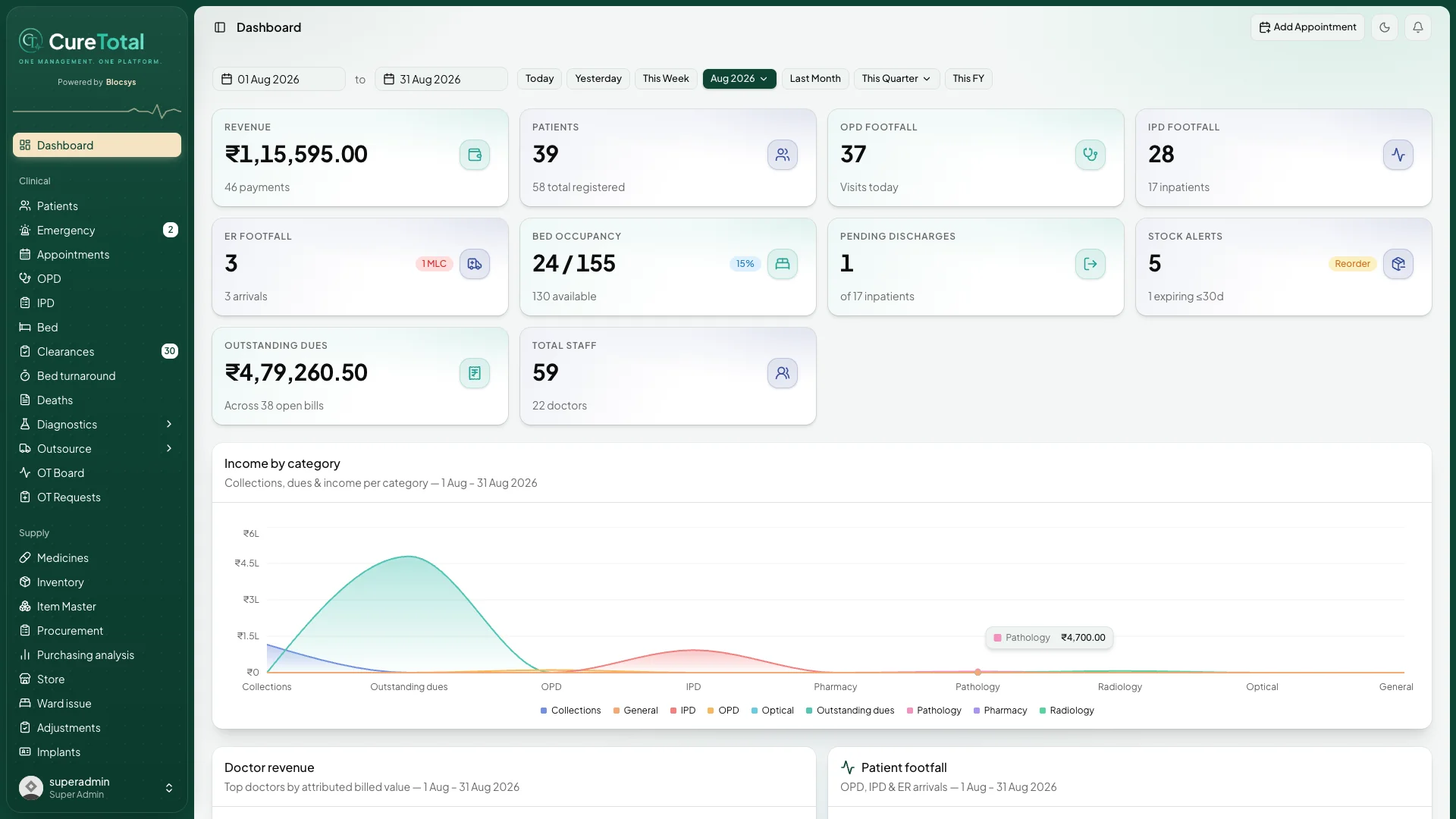
TL;DR: A Hospital Management System (HMS) manages core hospital workflows such as patient registration, appointments, OPD, IPD, billing, diagnostics, pharmacy and clinical operations. A Hospital ERP extends this operational foundation into enterprise functions such as finance, HR, procurement, inventory, assets and management analytics. In India in 2026, modern hospital software increasingly needs interoperability, ABDM readiness, FHIR-based data exchange, analytics, security and AI-enabled automation.
Introduction
Indian hospitals are moving beyond basic hospital software. As healthcare organisations digitise more departments, hospitals increasingly need systems that connect clinical workflows, administration, finance, inventory, human resources, analytics and digital-health infrastructure.
This has created some confusion around the terms Hospital Management System (HMS), Hospital Information System (HIS), Hospital Management Software and Hospital ERP.
Are they the same?
Not exactly.
An HMS primarily focuses on managing hospital operations and patient workflows. A Hospital ERP extends software capabilities into broader enterprise operations such as finance, procurement, HR, supply chain and asset management.
However, the distinction is becoming less rigid.
Modern hospital platforms increasingly combine HMS, HIS and ERP capabilities into an integrated digital environment. Current Indian healthcare technology discussions are also placing greater emphasis on ABDM, FHIR, AI, healthcare data standards, analytics and interoperability.
What Is a Hospital Management System?
A Hospital Management System (HMS) is software designed to manage the operational and clinical workflows of a hospital.
Depending on the platform, an HMS can include:
- Patient registration
- Appointment scheduling
- OPD management
- IPD management
- Emergency management
- Doctor workflows
- Nursing workflows
- Electronic medical records
- Laboratory management
- Radiology
- Pharmacy
- Billing
- Discharge management
- Reports
- Inventory
- Patient communication
The objective is to connect different hospital departments through a shared digital system.
For example:
Patient Registration → OPD → Doctor Consultation → Lab → Pharmacy → Billing → Discharge
Instead of entering the same information into separate systems, an integrated HMS can allow information to move between connected departments.
The National Informatics Centre’s NextGen eHospital platform illustrates this broader approach, with modules covering registration, appointments, IPD, EHR, billing, laboratory, radiology, pharmacy, stores and other hospital workflows.
What Is a Hospital ERP?
A Hospital ERP** (Enterprise Resource Planning)** system manages the broader business and administrative operations of a healthcare organisation.
Typical ERP capabilities include:
- Finance and accounting
- Procurement
- Purchase management
- Inventory
- Supply chain
- Human resources
- Payroll
- Asset management
- Vendor management
- Budgeting
- Cost management
- Financial reporting
- Management dashboards
A hospital ERP becomes particularly important when a healthcare organisation has multiple departments, locations, large inventories, complex financial processes or a growing workforce.
In simple terms:
HMS manages healthcare operations.
ERP manages enterprise operations.
An integrated hospital platform connects both.
HMS vs Hospital ERP: What’s the Difference?
| Area | Hospital Management System | Hospital ERP |
|---|---|---|
| Patient registration | ✓ | Usually integrated |
| Appointments | ✓ | Usually integrated |
| OPD/IPD | ✓ | Integrated |
| Clinical workflows | ✓ | May be integrated |
| EMR/EHR | Often | May integrate |
| Laboratory | Often | Integrated/connected |
| Pharmacy | Often | Integrated |
| Billing | ✓ | ✓ |
| Finance & accounting | Basic/varies | ✓ |
| Procurement | Basic/varies | ✓ |
| Inventory | ✓ | Advanced |
| HR & payroll | Sometimes | ✓ |
| Asset management | Sometimes | ✓ |
| Supply chain | Limited/varies | ✓ |
| Enterprise analytics | Varies | ✓ |
| Multi-location management | Depends on platform | Stronger focus |
The exact boundary varies between software vendors. Some modern platforms market themselves as HMS while incorporating substantial ERP capabilities, while others connect a hospital management system with a separate ERP. Current Indian software guides similarly describe the terminology as overlapping rather than completely standardized.
Why Are HMS and ERP Converging in 2026?
Hospitals don’t operate in isolated departments.
Consider a simple example.
A patient receives treatment.
That single event can create:
Clinical data → Lab order → Pharmacy requirement → Billing transaction → Inventory movement → Insurance claim → Financial entry → Management report
If each department uses a separate system, information can become fragmented.
An integrated hospital platform can connect these workflows.
This is why modern hospital software is increasingly moving toward a single digital operating environment instead of disconnected applications.
The current NextGen eHospital architecture from India’s National Informatics Centre also reflects this direction, combining multiple hospital modules with standards such as FHIR, LOINC, SNOMED CT and ABDM.
7 Key Features of Modern Hospital ERP Software
1. Patient and Clinical Management
A modern hospital platform should provide a connected patient journey.
Important capabilities include:
- Patient registration
- Appointment management
- OPD
- IPD
- Emergency
- Doctor consultation
- Nursing
- Clinical documentation
- Discharge
The objective is to create a consistent patient record across relevant workflows.
2. Hospital Billing and Revenue Management
Billing is one of the most important operational areas of hospital software.
A modern system can connect:
Services → Charges → Pharmacy → Diagnostics → Insurance/TPA → Invoice → Payment → Accounting
This reduces repetitive data entry and provides better visibility into revenue-related transactions.
Hospital ERP systems can further connect patient billing with finance and accounting.
3. Pharmacy and Inventory Management
Hospitals manage large quantities of medicines, consumables, equipment and other supplies.
An integrated system can help manage:
- Stock levels
- Purchase orders
- Suppliers
- Batch numbers
- Expiry dates
- Stock transfers
- Consumption
- Reordering
- Department-level inventory
When inventory is connected with pharmacy, billing and procurement, management can gain better visibility over stock movement and costs.
4. Finance, HR and Procurement
This is where the ERP component becomes particularly important.
Hospital ERP software can connect:
Procurement → Inventory → Consumption → Billing → Finance
It can also connect:
Employees → Attendance → Payroll → HR → Finance
This creates a more complete enterprise view of hospital operations.
5. Hospital Analytics and Dashboards
Data generated by an HMS or ERP should not simply remain inside databases.
Management needs answers such as:
- How many patients visited today?
- Which departments have the highest workload?
- What is the bed occupancy rate?
- Which medicines are approaching expiry?
- What is the outstanding billing amount?
- Which claims are pending?
- What are the major hospital expenses?
- Which services generate the most revenue?
This makes analytics and dashboards an increasingly important component of hospital software.
Healthcare management programs and current digital-health initiatives are placing considerable emphasis on using healthcare data for operational and management decisions.
6. ABDM and FHIR Integration
This is one of the most important areas for Indian hospital software.
The Ayushman Bharat Digital Mission (ABDM) is designed around an interoperable digital-health ecosystem using common standards and infrastructure.
The official ABDM FHIR implementation guide specifies FHIR R4-based requirements for exchanging health information in the Indian context.
As of July 20, 2026, the Government of India reported 94.87 crore ABHA IDs, along with 5.36 lakh registered health facilities and 10.09 lakh healthcare professionals. The government also describes ABDM as enabling secure, consent-based exchange between different digital-health systems.
For an HMS, this means interoperability should be considered during product architecture rather than added as an afterthought.
7. AI-Powered Hospital Management
Artificial intelligence is becoming another important layer in hospital software.
Potential applications include:
- Predictive analytics
- Automated reporting
- Clinical decision support
- Appointment optimization
- Patient-flow analysis
- Revenue analytics
- Inventory forecasting
- Claims analysis
- Automated documentation
- Intelligent alerts
The Government’s NextGen eHospital initiative specifically identifies AI-enabled functionality, predictive models and advanced technology as part of its future direction.
However, AI should complement hospital workflows rather than replace clinical judgement.
What Should Indian Hospitals Look for in HMS and ERP Software?
Before selecting hospital software, healthcare organisations should evaluate more than the number of modules.
1. Interoperability
Can the platform exchange data with other healthcare systems?
2. ABDM readiness
Can the platform support relevant ABDM workflows and standards?
3. FHIR support
Can the platform exchange structured healthcare information using applicable FHIR specifications?
4. Scalability
Can the software support increasing users, departments, beds and locations?
5. Security
Does it provide role-based access, authentication, audit logs, backups and appropriate data-security controls?
6. Configurability
Can the hospital configure:
- Forms
- Rate lists
- Workflows
- Approval chains
- Reports
- User permissions?
7. Analytics
Can hospital management access meaningful operational and financial insights?
8. Integration
Can the HMS connect with:
- LIS
- RIS/PACS
- Pharmacy
- Billing
- Payment systems
- Insurance/TPA systems
- External healthcare platforms?
Cloud vs On-Premise Hospital ERP
Hospitals also need to decide how their software will be deployed.
Cloud Hospital Software
Cloud deployment can provide:
- Remote accessibility
- Centralized updates
- Easier scalability
- Lower infrastructure requirements
- Multi-location accessibility
On-Premise Hospital Software
On-premise deployment can provide:
- Greater control over local infrastructure
- Local data hosting
- Custom infrastructure configuration
- Operation within an organisation’s own IT environment
Hybrid Deployment
Some healthcare organisations may choose a hybrid model depending on infrastructure, security, integration and operational requirements.
The right deployment model depends on the hospital’s size, IT capability, connectivity, security requirements and long-term technology strategy.
HMS + ERP + AI: The Future of Hospital Software in India
The next generation of hospital software is likely to move beyond simple record management.
A connected architecture can look like:
Patient
↓
HMS / HIS
↓
EMR + Laboratory + Pharmacy + Radiology + Billing
↓
ERP
↓
Finance + HR + Procurement + Inventory + Assets
↓
Analytics + AI
↓
ABDM + FHIR + External Healthcare Ecosystem
This model allows hospitals to connect clinical, operational, financial and enterprise data within a coordinated digital environment.
India’s public digital-health infrastructure is also moving toward interoperable, standards-based systems. The government launched the Unified Health Interface in June 2026 as an interoperable service layer of ABDM, reinforcing the broader direction toward connecting healthcare services across digital platforms.
How CureTotal Fits Into Modern Hospital Management
CureTotal is a Hospital Management System designed to help healthcare organisations manage and coordinate hospital operations through a configurable digital platform.
For hospitals, the value of an integrated system is not simply having more software modules.
The objective is to connect workflows.
For example:
Patient Registration
→ Appointment
→ Consultation
→ Diagnostics
→ Pharmacy
→ Billing
→ Reports
→ Management Insights
A configurable platform can also allow hospitals to adapt forms, rate lists, reports and approval workflows according to their operational requirements.
This approach is particularly relevant for hospitals that want to move from fragmented manual or departmental processes toward a more connected digital operating environment.
Frequently Asked Questions
What is the difference between HMS and Hospital ERP?
An HMS primarily manages hospital and patient-care workflows, while a Hospital ERP extends the system into enterprise functions such as finance, HR, procurement, inventory, assets and supply-chain management.
Is Hospital ERP better than HMS?
They serve overlapping but different purposes. A hospital should select a system based on its operational requirements, clinical workflows, financial processes, number of locations, integrations and scalability needs.
What modules should a Hospital Management System have?
Core modules can include patient registration, appointments, OPD, IPD, billing, pharmacy, laboratory, radiology, clinical records, inventory, reports and administration.
What modules should a Hospital ERP have?
Hospital ERP capabilities can include finance, accounting, procurement, inventory, HR, payroll, asset management, supply chain, budgeting, analytics and integration with hospital-management modules.
Is ABDM integration important for hospital software in India?
ABDM is designed to support an interoperable digital-health ecosystem in India. HMS platforms that need to participate in applicable ABDM workflows should consider relevant standards, APIs, registries, consent mechanisms and FHIR-based health-data exchange.
What is FHIR in hospital software?
FHIR, or Fast Healthcare Interoperability Resources, is a healthcare data-exchange standard designed to help different healthcare systems exchange structured information. ABDM’s health-data interchange specifications use FHIR R4.
Can HMS and ERP be integrated?
Yes. A hospital can integrate an HMS with an ERP so that operational, financial, inventory, HR and other enterprise information can move between systems.
Can AI be integrated into Hospital Management Software?
Yes. AI can be applied to areas such as predictive analytics, reporting, workflow automation, patient-flow analysis, inventory forecasting and clinical decision-support tools, subject to appropriate validation and governance.