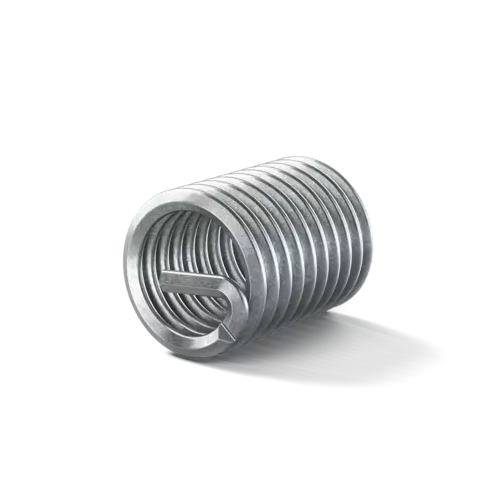
Aluminium is one of the most useful materials in modern engineering. It is light, easy to machine, corrosion resistant and strong enough for a huge range of components. But it has a well-known weakness: threads tapped directly into aluminium wear, gall and strip far more easily than threads in steel. That is why so many engineers choose to reinforce aluminium threads with inserts rather than rely on the parent material alone.
The Problem With Tapping Direct
When a steel fastener is tightened into a thread tapped directly into aluminium, the harder steel bears on the softer aluminium flanks. Each time the fastener is tightened and removed, a little material is worn away. Over repeated assembly cycles, the thread loosens, loses clamping force and can eventually strip completely. Galling, where the two metals adhere and tear under friction, can make the problem worse.
Heat and vibration add further stress. Engine components, pumps and machinery housings often run hot and vibrate constantly, both of which accelerate thread wear. In aerospace and automotive applications, the consequences of a failed thread can be serious.
How Wire Thread Inserts Help
Using wire thread inserts changes the way load is carried. A coil of hard stainless steel wire, formed with a diamond-shaped profile, is installed into a slightly oversized tapped hole. The fastener then threads into the stainless coil rather than the aluminium itself.
This has several benefits. The stainless wire is far more wear resistant than aluminium, so the thread survives repeated assembly. The flexible coil spreads load more evenly along the full length of engagement, rather than concentrating stress on the first few threads. And because the insert has a larger outer diameter than the fastener, it effectively increases the shear area in the parent material, allowing a stronger joint in the same space.
Choosing the Right Insert Type
For general reinforcement, free running inserts are the most common choice. They give a smooth, true-to-size thread and suit components that are assembled and disassembled regularly. Designers often specify free running HeliCoil Plus inserts for housings, covers and structural brackets.
Where vibration is a concern, screw-locking inserts add a gripping section that holds the fastener firmly and resists loosening, removing the need for additional locking devices. The standard range of screw-locking inserts is widely used in engines, gearboxes and compressors.
Insert length also matters in aluminium. Because the parent material is softer, longer inserts, such as 2D or 2.5D, are often chosen to give extra thread engagement and pull-out strength.
Design Advantages Beyond Strength
Reinforcing threads with inserts also gives designers more flexibility. Smaller bosses and flanges are often possible because the insert carries load so efficiently. Components can be made lighter without sacrificing thread reliability. And if a thread is ever damaged in service, it can be repaired with a replacement insert rather than scrapping an expensive casting or machined part.
Across electronics, automotive and aerospace, this combination of lightweight material and durable threads has made inserts a standard feature on engineering drawings rather than a specialist add-on.
What to Do Next
If your designs use aluminium components with threaded holes, especially ones that are assembled repeatedly or exposed to vibration, it is worth reviewing whether inserts should be specified from the start. Thor International supplies original HeliCoil wire thread inserts and tooling in Singapore and across Southeast Asia, and can help engineers choose the right insert type and length for their application.